Showing posts with label proposal. Show all posts

Wednesday, June 16, 2010

Proposals, Part 3: Making Your Proposal Package Presentable!

This is the last installment of my proposal series, putting it all together! Now there are two ways of doing this—through email or through hard copy. 


1) Hard Copy


Although many publishers these days accept email submissions (even if they aren't primarily ebook publishers), some still request paper submissions only. Firstly, you will want to follow their formatting guidelines, if they post any. If they do not, assume that they want industry standard, which is:


  • Double-spaced

  • 12-point font

  • Times New Roman or Courier New

  • 1-inch margins

  • A header with: the page number, your last name, and the title of your manuscript.

  • A cover page with: the title, your name and contact information (address, phone number, email address), approximate wordcount for the manuscript, and sometimes a short blurb like you would put in your cover letter.

Once you have printed out your manuscript (or more likely, the first three chapters), along with your cover letter and synopsis, all that needs to be done is to package it. Don't put it in a fancy box or tie it with ribbon—however much you might want to dress it up, it is better if it is plain. It should be able to stand out without the fancy wrapper, at this point. Don't staple it together, either. A paperclip works—or you could try my method. I slide my manuscript into a full-sized freezer bag. It's simple, it's easy—it's waterproof—and it gets the job done. 


2) Email


Personally, I prefer email. My main reason: because I live in Canada. Many of the publishers I send to are based in the U.S. and unfortunately, that can mean some pretty pricey postal charges. Fortunately, as I stated before, most publishers now also accept email submissions. 


Making your manuscript presentable through email is just as easy as through hard copy. If the publisher doesn't specify on a format, assume industry standard. And always, always, always make sure that your submission is free of misspelled words and grammar mistakes. That means for Canadian writers such as myself—make sure you have the word processor set to English (U.S.) and not English (Canadian)!


Another tip to watch out for is in naming your file. Some publishers give you instructions on how they would like the manuscript to be named. If they don't, a good rule of thumb is to have both the title and your name in the file name. For instance, using my example from the first part of this mini-series: ClaraHanoux_VampiresPreferBrunettes.doc or Hanoux_Vampires Prefer Brunettes.doc or some even use their initials:  CH_Vampires Prefer Brunettes.doc. It is important to have something in the name to identify who the submission belongs to.


Because this is the last part of this mini-series, if anyone has any lingering questions that I didn't cover, feel free to ask them below! If I can't answer them, I'll be sure to find someone who can.


Clara.


Sunday, June 13, 2010

Proposals, Part Two: The Brilliant Synopsis

The second part of your proposal package is the synopsis. This is the part of the proposal I always groan to write. After all, the readers—the people I am essentially trying to reach through my storytelling—they are never going to read it. In fact, even editors don't read it with the object of being entertained. When an editor reads a synopsis, it is with the object of seeing if the contained story has an engaging and thrilling plot. Therefore, when writing a synopsis, you should be sure to list anything important. 


However, beware of listing everything. Aside from the limited page count which most publishers insist on, reading it might become tedious. As the synopsis is a sample of your writing style as well as an outline of your plot, you most certainly do not want your editor to become bored while reading. Limit yourself to listing only major characters and events, turning points or any event which is necessary to explain the path to the climax. Details—like how the main character paused in her walk to admire the orange-yellow leaves on the trees—aren't necessary unless they move the plot forward somehow—for instance, if the only reason she met the hero was because she paused to look at those leaves. If it's not important, don't put it in the synopsis. Don't worry, someone will still read those brilliant scenes when they get to the actual novel. 


Lastly, when writing your synopsis, be sure to keep a rhythm, same as when you're writing a novel. No two sentences in a row should start with the same word, unless you're using them for effect. Break the paragraph if it gets to be too long. Also, when listing your main characters for the first time, put their NAMES in capital letters. That way, the editor knows that they are important. (Although some editors, like those at Ellora's Cave, state that this method is outdated. Read their tips for a successful synopsis!)


On Wednesday I'll be moving on to Making Your Proposal Package Presentable! 


Clara.

Wednesday, June 9, 2010

Proposals, Part 1: Dazzling Queries

Don't you wish sometimes that you knew all the secrets to the publishing business? Unfortunately, I can't promise to tell them all to you—I'm not an editor, after all—but I will share with you the few tidbits I have learned. 


If you search through the pages of any how-to book, it will tell you to keep your query (or cover letter) short. But how are you possibly supposed to dazzle an editor in a page or less? Here is my formula:


1) Start with a tantalizing synopsis, like you would find on the back of a book. That's how many authors catch my attention—if the back blurb makes the book sound like it's worth reading. You must do the same in order to catch the attention of the editor you're querying. 


2) In the second paragraph, list any publishing credits—or if you've never been published, list any relevant courses you've taken (for instance, if you have your Writing for Publication certificate, or even better, you B.A. in Creative Writing). Your blog—especially if you have a large amount of followers—is something you could mention, and give a link to. So long as you don't trash editors or the publishing company you're sending to, this will provide the editor with a flavour of your writing, or an opportunity to see your existing fan base.


3) End quickly, with a short sentence thanking the editor for their time, and if applicable, how you would rather be contacted (through email, etc.). Remember to address it to the editor, if possible (sometimes no matter how hard you search, the editor just isn't listed on the site, and that's ok too). End respectfully: Sincerely, Regards, Respectfully Yours. NOT something like Peace Out, Toodles, or Ciao!


Let me backtrack to the tantalizing synopsis again. This is the most important part of the query letter, but how are you supposed to let your brilliant story shine through in only a few sentences? My method is this: I try to boil the main conflict down to only a few sentences, two or three at most. Then, if possible, I try to add a hook, a question at the end. For instance, below I will paste the blurb for a short story I recently send out to a publisher:


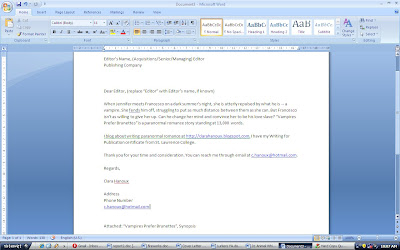
When Jennifer meets Francesco on a dark summer's night, she is utterly repulsed by what he is—a vampire. She fends him off, struggling to put as much distance between them as she can. But Francesco isn't as willing to give her up. Can he change her mind and convince her to be his love slave?


And now, let me show you two queries for the same story. The first is if you were going to print it out and send it by paper. The second, if you were going to send it by email. The differences are subtle, but they are there.


Does anyone else out there have some secrets to a dazzling query that they would like to share? Comment below!


Clara.